


Most advertisers hit the same wall somewhere between $300 and $600 a day. CPA creeps up, frequency climbs, and the account that printed money at $100/day suddenly looks fragile. The instinct is to blame the algorithm or the audience. In most accounts I've diagnosed, the real constraint is creative supply. Budget grew faster than the ads feeding it, and Meta's delivery system charged you for the gap.
Why creative is the real bottleneck in scaling
Meta's delivery system rewards accounts that give it fresh signal. Every budget increase asks the algorithm to find more people, faster, at the same efficiency. It can only do that with enough creative variation to reach different audience segments without showing the same ad to the same person five times in a week. Raise spend without adding ads and you are asking one asset to do the work of five.
That is why the "raise budget 20% every few days" advice found in nearly every scaling guide only gets you halfway. It is a reasonable pacing rule. Meta itself warns that significant budget edits can restart the learning phase. But it says nothing about what has to be true on the creative side for that pacing to hold at higher spend. Scale the dollars without scaling the assets and CPA drifts the whole way up the curve.
Budget scaling without creative scaling isn't a strategy. It's a countdown to fatigue.
The four phases of budget scaling, mapped to creative supply
Each phase below is more than a spend tier. It is a different creative operating model. Treat them as distinct stages rather than one continuous ramp, and you avoid carrying a $100/day creative cadence into a $700/day account.
Phase 1: $100-$250/day, proof of concept
Here you are still validating offer-audience fit. The goal is signal clarity, not volume. You need enough diversity to find 2-3 angles that work, but not so much that you can't tell what is driving results. This is where how many ads to test on Facebook matters most. Test too few and you scale a mediocre winner. Test too many and budget per ad falls below what Meta needs to exit learning.
Phase 2: $250-$500/day, angle expansion
You have a working angle or two. Now the job is building depth around them, not pouring more spend into the same three ads. Most accounts get this phase wrong. They double budget on the winning ad set and expect the winning ad to carry it. One ad, however strong, rarely absorbs a 3-5x budget increase without frequency pushing into fatigue territory within a couple of weeks.
Phase 3: $500-$750/day, format and placement diversification
Now you need creative that works across Reels, Stories, feed, and Advantage+ placements, each with its own pacing and aspect ratio. Saturation also tends to show up by placement before it shows up account-wide, so fatigue monitoring has to get more granular.
Phase 4: $750-$1,000/day+, sustained volume
At this tier you are no longer hunting for winners. You are running a production pipeline that replaces a meaningful share of your active ads every week. Accounts that plateau here usually have a testing framework built for Phase 1 volume still running at Phase 4 spend.

How much new creative you actually need at each tier
There is no magic number. But the ratio between spend and fresh creative volume is exactly what most scaling advice skips. Treat the figures below as a working baseline from account audits, then adjust for your vertical, price point, and audience size:
| Daily spend tier | Fresh creative needed per week | What changes operationally |
|---|---|---|
| $100-$250/day | 3-5 new ads | Hand-built, hypothesis-driven, slow iteration is fine |
| $250-$500/day | 8-12 new ads | Need a repeatable production process, not one-off creative |
| $500-$750/day | 15-20 new ads | Requires templated variation across hooks and formats |
| $750-$1,000/day | 20-30+ new ads | Manual production breaks here without AI-assisted generation |
Approximate weekly volume to keep frequency and CPA stable as budget scales. A starting point, not a law.
At this point the facebook ad creative testing framework for 2026 stops being a nice-to-have and becomes operationally critical. Testing cadence has to compound with budget, not trail it. If you're still testing in batches of three at $600/day, you don't have a testing problem. You have a production capacity problem wearing a testing problem's clothes.
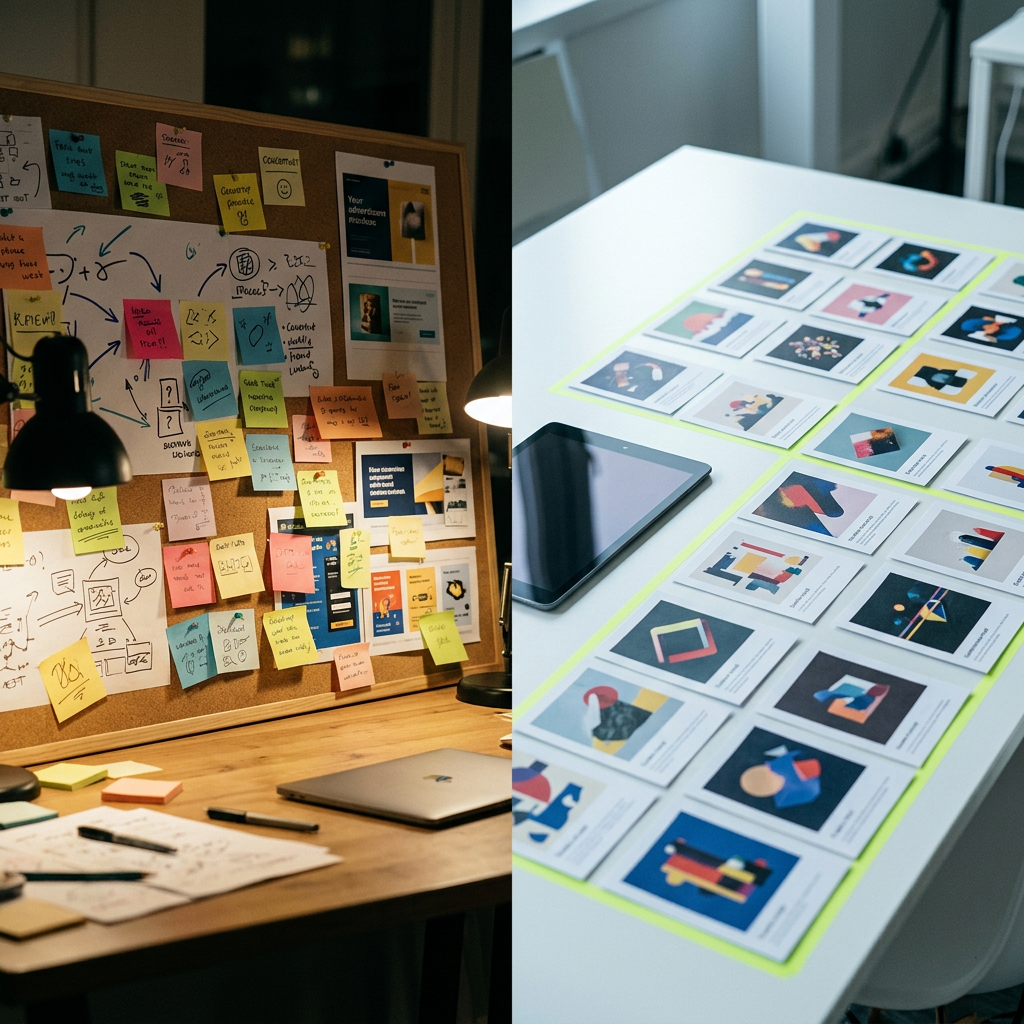
A grid like this is roughly one week of Phase 2 output. By Phase 4 you are running three or four of them in parallel, across different offers or audience segments.
Avoiding fatigue while scaling aggressively
Scaling and fatigue are tied to the same variable: how often one person sees one creative. Raise budget without raising creative supply and frequency climbs faster than it should. That's arithmetic, not bad luck. The warning signs are covered in how to spot and fix Facebook ad creative fatigue, but scale raises the stakes. At $100/day, a fatigued ad means slow CPA drift over a month. At $750/day, the same pattern burns real money within days.
- Segment fatigue monitoring by placement. Reels and feed frequency can diverge quickly as budget grows, so a single account-level frequency number hides the problem.
- Rotate in net-new hooks weekly, not whole new concepts. You don't need to reinvent the angle every week. You need fresh openings on angles already proven to convert.
- Retire ads at the frequency threshold, not the performance cliff. If you wait for CPA to visibly break, you've already spent days funding a dying ad.
- Keep one or two "anchor" ads live longer. Not everything needs replacing weekly. Durable anchors give the algorithm stability while you rotate the rest.
The point: fatigue at scale is usually a volume problem, not a quality problem. More budget chasing the same ad count pushes frequency up, however good the ad is.
Using AI ad generation to keep pace with scaling velocity
Here most in-house teams, and plenty of agencies, hit a wall that has nothing to do with strategy. The framework holds up. The trouble is producing 20-30 genuinely distinct ads a week by hand, with new hooks, new formats, and on-brand execution. Few teams are staffed for that. It is the gap that AI Facebook ad creative generators built for on-brand scale are designed to close. The goal isn't volume for its own sake. It's holding the ratio of fresh creative to spend that keeps frequency and CPA stable through each phase.
Done well, AI handles the variation work: new hooks, new visual treatments, new format crops. Your team keeps ownership of the angles and offers that need human judgment. Done badly, it just produces noise faster. The accounts that scale cleanly from $100 to $1,000/day use AI-assisted production to hit the weekly volume targets above consistently, not as a substitute for strategy.
Signals that creative supply is limiting your scale
Before you blame bidding, audiences, or the algorithm, check these. They show up repeatedly in accounts that stall below their target spend.
| Symptom | Common wrong diagnosis | Actual cause |
|---|---|---|
| CPA rises 2-3 days after a budget increase | "Algorithm needs to re-learn, just wait" | Same ad set absorbing budget increase with no new creative input |
| Frequency above 4 within 7 days | "Audience is too small, expand targeting" | Not enough creative variants rotating through that audience |
| Winning ad ratio drops as spend rises | "We're running out of good ideas" | Testing cadence didn't scale with budget, so sample sizes per test shrank |
| New campaigns underperform the old ones | "This audience segment just isn't as good" | New campaigns are reusing the same creative pool as the saturated one |
If two or more of these look familiar, a bidding change won't save you. Go back to the creative tier table and check whether your weekly output actually matches your current spend.
Key takeaways
- Keep budget increases to roughly 20-30% every 3-4 days, since large edits can restart learning, and pair each step with new creative rather than more spend on existing ads.
- Creative volume should scale with spend tier, from roughly 3-5 new ads a week at $100/day to 20-30+ at $1,000/day.
- Weekly frequency above 3-4, segmented by placement, is one of the earliest signals that creative supply is capping your scale.
Bringing it together
Profitable scaling on Facebook was never mainly a budget-pacing problem. Meta gives you a sense of how fast you can raise spend. It doesn't tell you that every added dollar needs fresh creative behind it, or frequency and fatigue will eat the efficiency you built. Treat the four phases as a creative production roadmap as much as a spend roadmap. Match your testing cadence to each tier, and bring in AI-assisted generation once manual production can't keep up. Do that, and the climb from $100 to $1,000 a day becomes a series of manageable steps instead of a cliff.
Put this into practice
Generate on-brand Meta ads — angles, formats, hooks and copy — in minutes.
Start freeFrequently asked questions
Meta notes that significant budget edits can send an ad set back into the learning phase. The common practitioner rule of thumb is increases of roughly 20-30% every 3-4 days. Bigger jumps tend to force the algorithm to re-explore, which is why creative supply, not budget alone, becomes the real constraint.
Vertical scaling raises budget on an existing ad set. Horizontal scaling duplicates winning ad sets or campaigns into new audiences or placements. Most accounts get more out of horizontal scaling with fresh creative variants before pushing vertical budget past the point of diminishing returns.
Watch for frequency climbing past 3-4 within a week, CPA creeping up while budget holds flat, and a shrinking share of winning ads among total ads tested. If those appear before you reach your target daily spend, your creative pipeline is the likely bottleneck.
Keep reading

How to Build a Facebook Ads Creative Calendar That Prevents Fatigue
A tactical system for planning hooks, angles, and refresh cadence so creative fatigue never catches your account off guard.

How to Scale a Winning Facebook Ad Without Killing Performance
A practical guide to scaling winning Facebook ads with budget, audience, and Advantage+ moves that avoid fatigue and CPA spikes.

Facebook Ad Creative Best Practices for 2026: The Data-Backed Playbook
A practitioner-grade 2026 playbook for static, video, and carousel Facebook ad creative, backed by real performance patterns and fatigue signals.