


If you've run Meta campaigns over the past year, you know the feeling. "Generate with AI" appears inside Ads Manager, and you hesitate. The copy sounds plausible. The image looks fine at a glance. Then you notice the problems: a claim that's slightly too bold, a tone that isn't yours, a visual that could belong to any company in your category. That gap between "AI-generated" and "usable" explains why brands are pushing back on AI ad tools. It costs marketers approval cycles and brand equity, and it can lead to policy rejections.
Why brands are losing trust in Meta's native AI ad tools
Meta is pushing advertisers toward AI-assisted creative, and its reasons are easy to see. More ad variants give its delivery system more combinations to test. What helps Meta's delivery doesn't automatically help the brand paying for it, though. Native generation tools are built for volume and variety. They aren't built to stay faithful to a specific brand voice, visual system, or claims policy.
None of this is a knock on Meta's brand safety infrastructure, which is fairly mature. The Brand Safety and Suitability Center gives advertisers controls over where ads appear. The Advertising Standards set firm rules on what ad content is permitted, from discriminatory practices to misleading claims. Every ad, AI-generated or not, is reviewed against those standards. By Meta's definition, that is brand safety: appropriate placement and policy-compliant content.
The missing piece is brand suitability as a marketing team means it. Does this ad sound like us, look like us, and represent our product honestly and specifically? An AI-generated ad can clear every platform check and still be something your brand manager would reject, because "not against the rules" and "on-brand" are different bars. That is the core of the trust problem, and it's why more advertisers now read the fine print before giving any AI tool access to their ad accounts. For a structural breakdown of how Meta's own AI tools differ from dedicated creative platforms, see this comparison.
The point: Policy compliance and brand fidelity are separate tests. An ad can pass Meta's review and still fail your internal review. That second failure is the one that costs revision cycles and credibility with stakeholders.
The gap between "AI-generated" and "on-brand AI-generated"
Ask performance marketers what they want from an AI ad tool and most will give some version of one answer: speed without losing control. Most AI ad generation, Meta's native tools included, treats brand identity as an afterthought. You supply a product URL or a short prompt. The tool infers a tone, picks visual elements, and outputs an ad, filling every gap with whatever is most common in your category. The result looks like everyone else's ads.
On-brand generation starts somewhere else, with locked inputs. These include your actual logo files, color values, approved product photography, tone-of-voice rules, and a library of claims your legal or compliance team has already approved. The AI's job is no longer to invent something plausible. Its job is to produce variations inside fixed boundaries. That problem is narrower and harder to solve well, and most generic tools skip it. For teams scaling output without giving up control, this guide to AI ad creative at on-brand scale lays out the operating model.
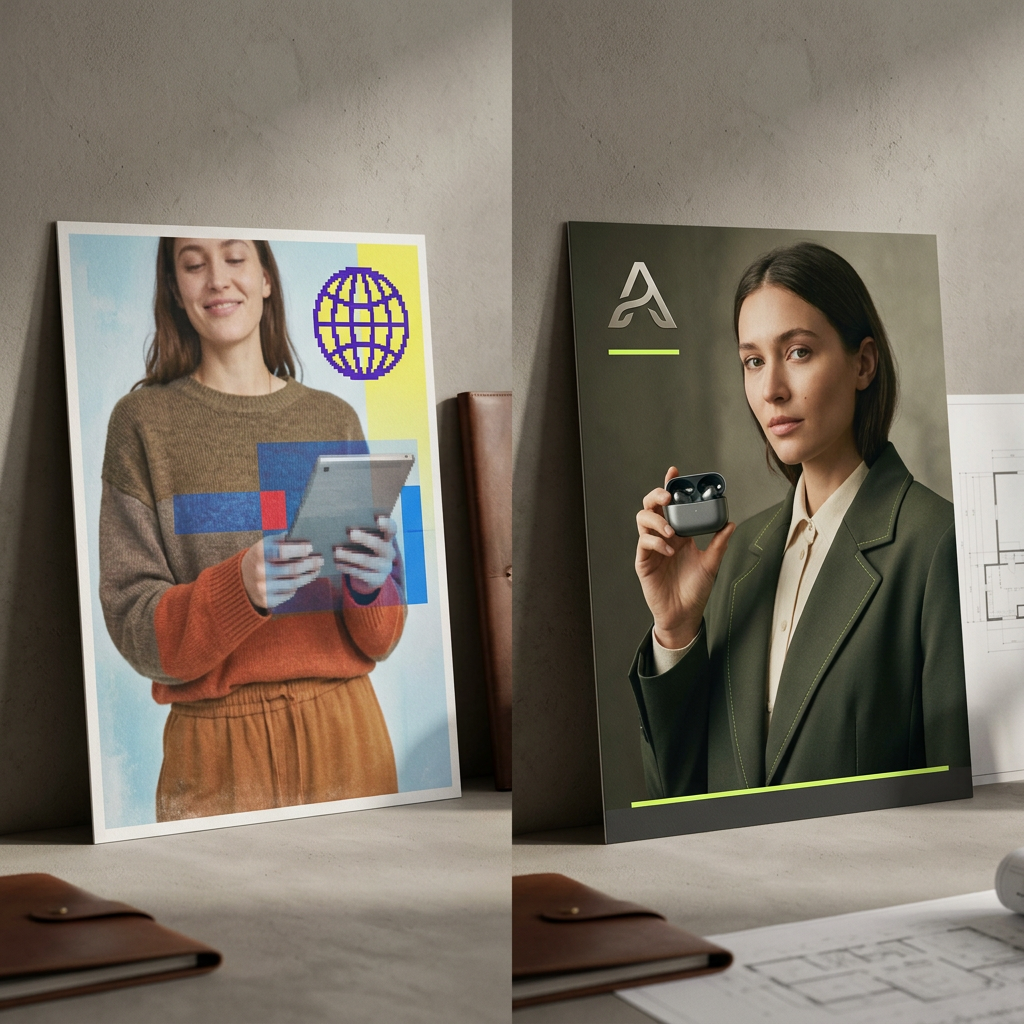
| Generic AI ad generation | On-brand AI ad generation |
|---|---|
| Infers tone and claims from a URL or short prompt | Pulls from locked brand voice rules and approved claim library |
| Uses stock-like or AI-rendered visuals loosely related to the product | Uses your actual product shots, logo files, and brand colors |
| Optimizes for plausible-sounding output at volume | Optimizes for compliant, on-brand variation at volume |
| Requires manual review of every asset before launch | Requires spot-checks, since guardrails are built into generation |
The model is the same in both columns. What changes is the material the AI is allowed to draw from.
Common failure points: misrepresentation, generic messaging, brand inconsistency
When teams flag problems with AI-generated Meta ads, the complaints tend to fall into a few recurring patterns.
- Misrepresentation. Models tend to overstate benefits or invent specifics that sound good and aren't true. Typical examples are a "60% faster" claim with no source, a feature the product lacks, or an implied guarantee legal never approved. This failure is the one most likely to cause policy trouble, because Meta's Advertising Standards explicitly prohibit misleading claims and deceptive practices.
- Generic messaging. Without brand-specific inputs, the model falls back on category language. Skincare ads promise a glow "from within." SaaS ads promise to "streamline your workflow." The copy isn't wrong. It just reads the same as everyone else's, and that gives the audience no reason to trust your brand in particular.
- Brand inconsistency. Visual drift is the most obvious failure: the wrong shade of blue, a substituted font, a logo crop that breaks your guidelines. Repeat that across dozens of auto-generated variants and your presence in the feed looks like five different companies.
- Context collapse. Tools that write copy from a landing page often miss nuance a human copywriter would catch, such as regulatory language required in certain industries, regional disclaimers, or phrasing suited to a specific audience.
The fastest way to lose a customer's trust in your brand is to let an algorithm guess what your brand sounds like.
Transparency deserves attention too. Meta is adding disclosure requirements for AI-generated and AI-modified content, and advertisers without proper creative governance will end up labeling and documenting assets after the fact. This breakdown of upcoming AI ad labeling requirements covers where the rules are heading. It's a strong argument for building brand controls into your process now so you don't have to retrofit them later.
How to vet AI ad creative tools for brand safety and control
For a marketing director, brand safety comes down to three questions. Can I control the inputs? Can I audit the outputs? Can I trust the tool not to publish something harmful without a human reviewing it first? Here's what those questions look like when you evaluate a platform.
Ask about data provenance
Where does the tool get its brand inputs? If the answer is "we scrape your landing page," you'll get the same generic output as Meta's native tools. Choose platforms that let you upload and lock real brand assets: logo files, an approved palette, tone-of-voice documentation, and a claims list that goes through legal review once and gets reused every time after.
Check for human-in-the-loop defaults
Full automation sounds appealing until an unreviewed ad with a misrepresented claim goes live across twelve ad sets. A trustworthy tool puts the review step before publishing, not after. If a platform steers you toward "fully autonomous" campaign management with no easy point to pause and review, treat that as a warning sign.
Compare against the alternatives you already know
Many teams start their evaluation with the established tools and work backward from there. If you've used AdCreative.ai, find out where its control gaps are before you switch. This comparison page sets the two tools side by side and covers how brand input handling and review workflows differ in practice, beyond what the marketing copy says.
Checklist: what to look for in an AI ad generator you can trust
- Brand inputs are locked assets (logo, colors, fonts, product imagery), not inferred from a URL scrape
- A pre-approved claims and messaging library that gets reused, not regenerated from scratch each time
- Full version history, so any live ad traces back to its source inputs and approval
- A default review step before anything publishes, with auto-publish as an opt-in
- Format and placement coverage (1:1, 4:5, 9:16) generated from the same brand-locked source, not from separate disconnected generations
- Documentation practices that support upcoming AI-content disclosure requirements
- A support model that measures brand consistency instead of vaguely promising it
Key takeaways
- Policy compliance and brand fidelity are separate bars. Meta's review checks the first. Only your own tooling can guarantee the second.
- Misrepresentation, generic messaging, and visual drift are the most common failures in native AI ad generation. All three come from weak or missing brand inputs.
- Avoiding AI won't fix this. Locking brand inputs, claims, and review steps into the generation process will.
Where this leaves performance marketers
Brands aren't rejecting AI. They're rejecting unaccountable AI: tools that generate confidently with no way to stay inside a brand's rules. Meta's brand safety infrastructure handles placement and policy reasonably well. It was never designed to judge whether an ad sounds like your company. That job belongs to whatever creative tool sits between your brand guidelines and your ad account.
Platforms built on locked brand inputs, pre-approved claims, and human review checkpoints address the problem advertisers actually have. Creative output stays fast, and the volume Meta's algorithm rewards doesn't erode brand equity you spent years building. Test for that before you connect any AI tool to a live ad account.
Put this into practice
Generate on-brand Meta ads — angles, formats, hooks and copy — in minutes.
Start freeFrequently asked questions
It produces ads quickly, but it optimizes for broad engagement, not your brand guidelines. Without controls over tone, visual identity, and claims, it can generate copy and imagery that drift from how your brand actually sounds and looks.
Brand suitability covers the controls advertisers use to keep ads in appropriate contexts and to make sure the ad content reflects the brand accurately. It differs from brand safety, which focuses on avoiding harmful adjacent content.
AdGenz builds ads from your locked brand inputs, approved assets, and claim libraries, so every variant stays on-brand by construction instead of relying on a generic model to guess your voice from a URL.
Keep reading

Advantage+ Creative Isn't Killing Your Control: A Hybrid Workflow Guide
A practical hybrid workflow that pairs Advantage+ automation with deliberate, on-brand creative inputs so Meta personalizes your strategy instead of improvising one.

Meta Ads Brand Safety: How to Protect Your Ad Account From AI Ad Scandals in 2026
Meta's AI moderation failures put ad accounts at risk. Here's how to audit your creative and pick AI ad tools built for brand safety in 2026.

Meta's New AI Ad Labels: What Advertisers Must Disclose in 2026 (and How It Affects Your Creative)
A practical breakdown of Meta's expanded AI ad label policy: what triggers disclosure, whether it hurts CTR, and how to stay compliant.