
Every AI ad generator on the market can now produce a scroll-stopping image or a passable UGC-style video clip in under sixty seconds. That part is basically solved. Nobody has solved the harder part: knowing which sixty-second output actually deserves ad spend behind it. That gap is where most teams lose money in 2026. AdCreative.ai claims over 4.2 million businesses and $35B+ in ad spend data behind its engine. Creatify says it has produced 15M+ ads against $1B+ in tracked spend. Those numbers prove generation is commoditized. They don't prove any of those ads reached the right customer, said something new, or survived past day four.
What an AI ad creative generator actually does
Strip away the marketing language and every AI ad generator does one of three things, often blended: templated assembly, generative synthesis, or strategic sequencing. Knowing which one you're buying determines whether the tool saves you time or just moves the bottleneck downstream.
Templated assembly takes a product photo or brand asset and drops it into pre-built layouts, resizing for placements automatically. Generative synthesis uses diffusion and video models to create net-new visuals, avatars, or B-roll from a text prompt, which is what powers Creatify's "turn a product page into a video ad" pitch. Strategic sequencing is the layer most tools skip: deciding which angle, hook, and format combination should exist in the first place, based on who you're trying to reach and what's already been tested. Generation without that sequencing is just a faster way to produce noise.
The three generations of AI ad tools
It helps to think about this market in generations, because the label "AI ad generator" now covers wildly different levels of sophistication.
- Generation 1: Templated. Early tools (and still much of Canva's ad workflow) auto-resize a design across placements and swap in brand colors. Fast, cheap, but the output is a formatted asset, not a tested creative concept.
- Generation 2: Generative. Tools like AdCreative.ai and Creatify generate net-new images, video, and avatar-led UGC from prompts or product URLs. This is where most of the market sits today, optimized for volume: hundreds of variants per brand, per week.
- Generation 3: Strategy-aware. A smaller set of tools reason about ICP, angle diversity, and testing structure before generating anything, so the output maps to a hypothesis rather than a random visual permutation. This is where creative volume turns into a learning system instead of a content farm.
The point: generation speed stopped being the bottleneck a couple of years ago. The bottleneck now is deciding what's worth generating, and almost no Generation 2 tool was built to answer that.
Where AI-generated ads commonly fail
Run more than a handful of AI-generated creative sets through Meta Ads Manager and three failure patterns show up so consistently they're practically predictable.
Generic hooks that all say the same thing
Prompt-based generation converges on the same three or four hook structures: a problem-agitate-solve script, a "wait for it" pattern interrupt, or a founder-style testimonial. Ask five different generators for "UGC ad hooks for a skincare brand" and you'll get variations on the same five ideas, because they're trained on the same corpus of high-performing ad transcripts. The output isn't wrong. It's just not differentiated, and Meta's auction rewards nothing that looks like everything else already competing for the same impression.
Weak ICP alignment
Most generators ask for a product URL or a short brand description and infer an audience from that. They rarely ask who the ad is for, what that person's specific objection is, or what stage of awareness they're in. The result is creative that's demographically plausible but psychographically hollow. If you haven't nailed down your ideal customer profile before you start generating, no amount of AI polish fixes that upstream gap. That's why building the ICP first matters more than which tool you pick.
Fast creative fatigue
Generative tools are excellent at producing 50 variations of one concept and mediocre at producing five genuinely different concepts. That matters because Meta's fatigue curve punishes concept repetition, not just literal ad repetition. Once frequency creeps past 2.5 to 3 on a single angle, ten visual variants won't save you. CTR tends to decline at roughly the same rate as running one static ad on repeat. Volume without conceptual diversity just speeds up the burn.
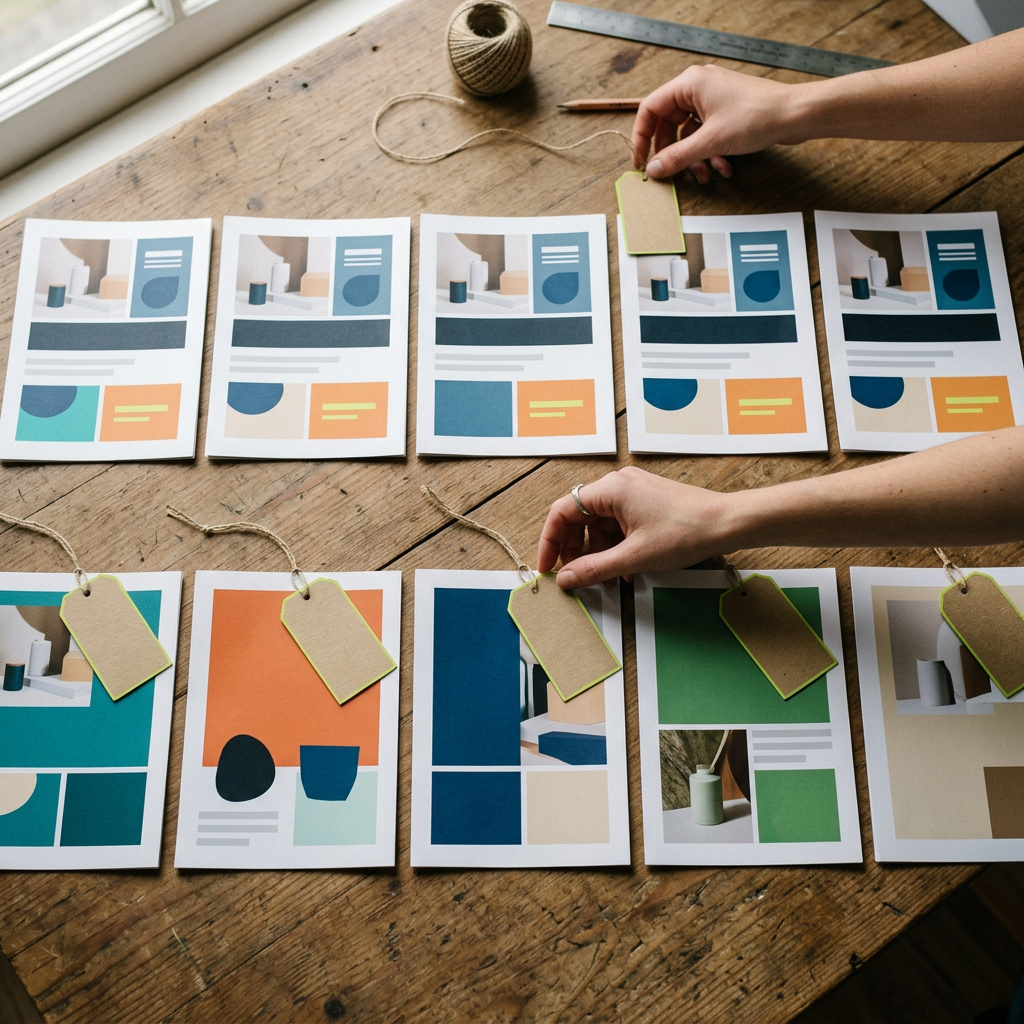
| Generic AI generation | Strategy-aware generation |
|---|---|
| Prompt in, 50 visual variants of one idea out | ICP segments and awareness stages mapped before any asset is made |
| Hooks converge on the same 3-4 patterns across brands | Hook diversity forced across pattern-interrupt, testimonial, stat-led, and contrarian angles |
| No built-in link to what's already been tested | New creative references past test results, kills, and winners |
| Fatigue tends to show up within days at scale | Angle rotation planned before fatigue thresholds are hit |
Generation solves production speed. Strategy solves the actual problem, which is knowing what's worth producing.
An AI generator that doesn't know your ICP isn't saving you time. It's producing rejections faster.
A 6-point framework for evaluating any AI ad generator
Before you sign up for another 14-day trial, run the tool through these six checks. Most fail at least two.
- Does it ask about your ICP before generating? If the only input is a URL or a product photo, the tool is guessing at audience. A real evaluation should probe for pain points, objections, and awareness stage.
- Does it enforce hook diversity, or just visual variety? Ten color variants of the same script is not ten hooks. Check whether the tool structurally separates concept generation from asset generation.
- Can it explain why it made a creative decision? If a tool can't tell you which angle or data pattern informed a given ad, you can't learn from wins or losses, only repeat them by luck.
- Does it connect to a testing structure? Generation without a feedback loop back into performance data is a one-way pipe. Look for native integration with ad account data, or at least a clean export into a structured testing framework.
- What's the actual cost per usable asset? A $99/month plan that produces 200 generic variants, three of them usable, costs more per usable ad than a $300/month plan that produces 20 targeted concepts, twelve of them usable.
- Does it degrade gracefully at your volume? Tools built for solo creators (Canva Grow, Pencil) often buckle on brand consistency and ICP nuance once you're running 15+ SKUs or multiple audience segments at once.
Combining AI generation with a real testing framework
The output of any generator, no matter how good, is only as useful as the test structure you drop it into. Most teams skip this part because it's less exciting than watching a video ad render in real time.
Start with the angle, not the asset. Define three to five distinct ICP-aligned angles before you open any generator. Then use the tool to produce format and hook variants within each angle, not across a single generic theme. Launch with a structured ABO or CBO test that isolates angle performance early, before you spend budget differentiating hooks inside a losing angle. Set fatigue thresholds in advance (frequency above 3, CTR decline past roughly 20% week-over-week) and have the next angle ready before you hit them, rather than scrambling mid-fatigue. This sequencing, angle first, format second, generation last, is the difference between a tool that produces content and a system that produces learnings. It's the exact workflow we lay out in our creative testing framework, which pairs with any generation tool once your ICP and angles are locked.
Tool-by-tool snapshot
Here's a quick read on where the major players sit, useful if you're shortlisting.
| Tool | Strongest at | Weakest at |
|---|---|---|
| AdCreative.ai | Volume and platform sizing, backed by claimed $35B+ ad spend data | Angle diversity; leans on pattern-matched templates. Full breakdown in our AdCreative.ai alternatives guide |
| Creatify | Video and UGC-style avatar ads at genuine scale (15M+ ads created) | Strategic ICP input is thin; see our Creatify comparison |
| Pencil | Fast iteration for performance marketers already running Meta campaigns | Brand consistency across multiple product lines, covered in our Pencil alternatives breakdown |
| Jasper | Ad copy and messaging variation, strong for text-first testing | Visual and video generation is secondary, bolted onto a broader content platform |
| Lapis | Fast-turn static ad generation for e-commerce catalogs | No native strategic sequencing layer, detailed in our AdGenz vs Lapis comparison |
None of these are wrong choices. They're production tools. The question is what sits above them.
Key takeaways
- Generation speed is commoditized. The scarce resource in 2026 is knowing which concept deserves to be generated.
- Most AI ad tools fail on hook diversity and ICP alignment, not visual quality, which is why fatigue hits fast even with hundreds of variants.
- Evaluate any tool on ICP input depth, hook diversity, explainability, testing integration, cost per usable asset, and scale behavior, not just render quality.
Where AdGenz fits
AdGenz isn't trying to out-render Creatify or out-volume AdCreative.ai. It sits above the generation layer: mapping your ICP and angles first, then directing generation toward a structured test plan instead of a pile of visually similar variants. If you're already running a generator and burning through creative faster than you can learn from it, the fix usually isn't a better renderer. It's a strategy layer that tells the renderer what to make.
Put this into practice
Generate on-brand Meta ads — angles, formats, hooks and copy — in minutes.
Start freeFrequently asked questions
It's software that produces ad images, video, or copy from prompts, product feeds, or brand inputs using generative models, template logic, or a mix of both. The output ranges from resized templates to fully synthesized video with AI voiceover.
No. They replace the production bottleneck, not the strategy layer. You still need ICP definition, angle selection, and a testing framework to decide what to make and what to kill.
It depends on whether you need volume (Creatify, AdCreative.ai), design polish (Pencil, Canva Grow), or a strategic layer that maps creative to ICP and testing cadence, which is where AdGenz is built to sit.
Keep reading
How Many Ad Creatives Should You Test on Meta? A Data-Backed Framework
A budget-based, funnel-stage framework for exactly how many Facebook ad creatives to test, from $20/day to $10k/month.
Meta Ads Creative Brief Template: What to Include Before You Brief AI or Your Designer
A practical Meta ads creative brief template covering the 7 elements that prevent wasted spend, early ad fatigue, and endless revision cycles.
How to Build a Meta Ads Creative Testing Calendar (Weekly & Monthly Templates)
A plug-and-play weekly and monthly Meta ads creative testing calendar with volume benchmarks, fatigue triggers, and AI-assisted production workflows.