
Most Meta ads that stop your scroll run on a copy skeleton older than the platform. AIDA traces back to the 1890s. PAS has been a direct-response staple since the mail-order era. The formulas haven't changed in 2026. The feedback loop has: Meta's creative-first delivery rewards strong copy faster and buries weak copy sooner. With Advantage+ handling much of the targeting and delivery, the hook and the copy are among the few levers you still hold. That makes a tested formula worth more today, not less.
Why copy formulas matter more in a creative-first algorithm
Meta's auction no longer rewards precise audience slicing the way it once did. Advantage+ campaigns work from broad audiences and let machine learning find buyers, which moves the burden of performance onto the creative. Your headline, primary text, and hook now do the job interest targeting used to do. They pull in the right viewer and wave off the wrong one in the first moments of a scroll.
A formula isn't a crutch for lazy writing. It's a repeatable structure that sequences attention, tension, and resolution in an order readers already expect, and that predictability is why formulas keep converting. They swap "what do I say first?" for a better question: "which proven structure fits this audience's awareness level?" For how these structures slot into a full creative system, see our guide on Facebook ad copywriting frameworks.
The point: when the algorithm picks the audience, the formula becomes your targeting tool. Weak copy earns thin engagement, and thin engagement limits how far the ad travels before it ever reaches likely buyers.
Top 5 proven copywriting formulas for Meta ads
These five formulas sit underneath a large share of the strong Meta ads you'll find in any vertical. Each solves a different psychological problem. Pair the wrong formula with the wrong funnel stage and a good product ends up with a bad CTR.
1. PAS (Problem-Agitate-Solution)
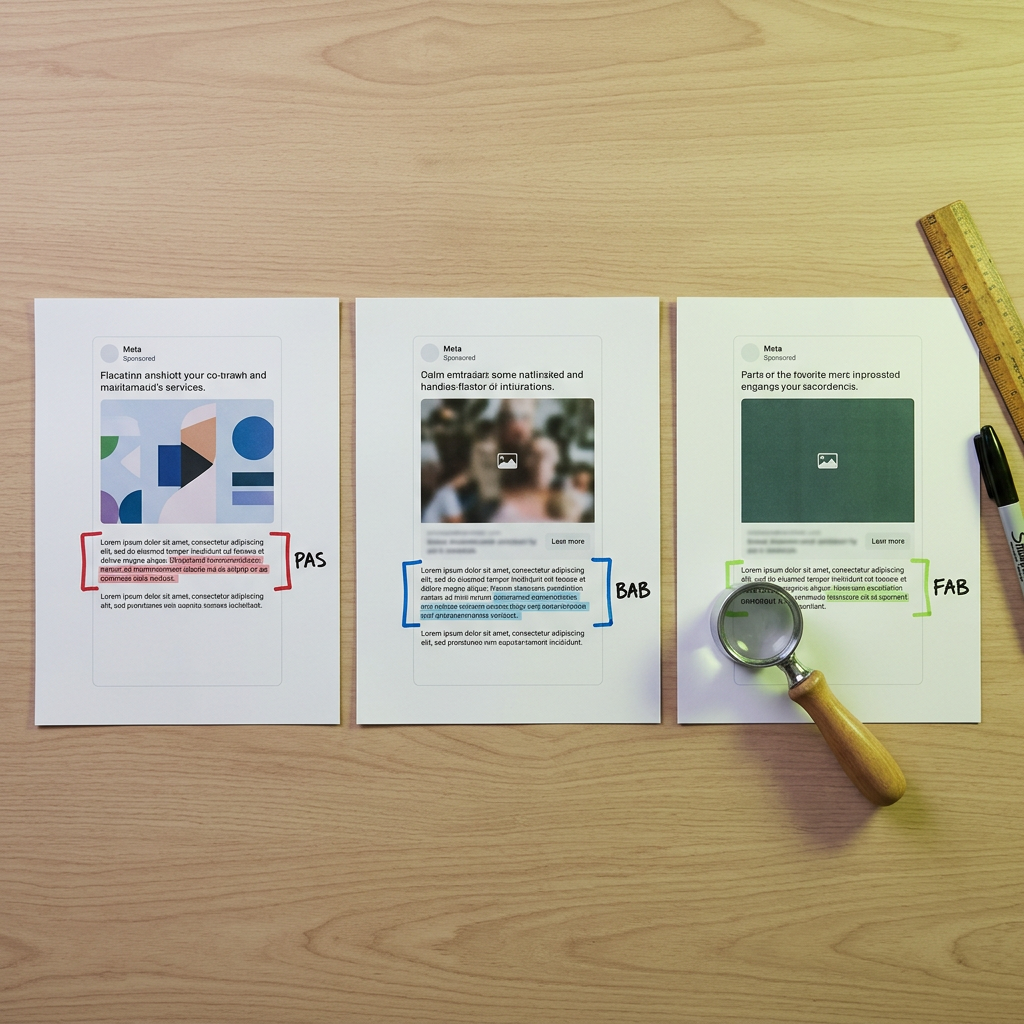
PAS names a problem the viewer already has, agitates the cost of ignoring it, then resolves the tension with your product. It's a reliable choice for cold traffic because the viewer doesn't need to believe they want a solution yet. You meet them inside a problem they're already living with.
Real-style example (skincare, cold):
"Your skin purges for weeks and you still don't know if it's working. (Problem) Meanwhile you've spent $200 on serums that promised results in 7 days and delivered nothing but irritation. (Agitate) This 2-step routine shows visible calming in 72 hours, dermatologist-tested, no purge period. (Solution)"
2. AIDA (Attention-Interest-Desire-Action)
AIDA is the oldest formula here and still the most versatile. It maps onto the four jobs every ad has: stop the scroll, hold attention a few seconds longer, build want, ask for the click. Use it when the product is the hero, not the problem.
Real-style example (SaaS tool, cold-to-warm):
"Most project managers waste 6 hours a week in status meetings. (Attention) This tool replaces the weekly check-in with a 30-second async update. (Interest) Teams using it report getting 2 extra focus hours back, every week. (Desire) Start your free 14-day trial, no credit card. (Action)"
3. BAB (Before-After-Bridge)
BAB describes the viewer's frustrating present, jumps to a better future, then shows the bridge (your product) between them. It's gentler than PAS, which suits warm audiences who know they have a problem but haven't committed to a fix.
Real-style example (fitness app, warm):
"Before: you start a new workout plan every January and quit by week 3. After: you've trained consistently for 90 days without burning out. Bridge: a plan that adjusts to your energy level daily, built by the people who kept 40,000+ users consistent past the 90-day mark."
4. FAB (Features-Advantages-Benefits)
FAB starts with a concrete spec, translates it into a functional advantage, then lands on the payoff for the buyer. It's underused on Meta, partly because founders who lead with features tend to stop there. When the audience is already comparing options, say in retargeting against a competitor, FAB supplies the proof points AIDA and PAS skip.
Real-style example (home goods, retargeting):
"Feature: double-walled stainless steel. Advantage: keeps drinks cold for 24 hours even in July heat. Benefit: you stop buying ice, stop watery coffee, and stop replacing a $9 bottle every summer."
5. FOMO / Urgency-Scarcity Stack
This one isn't a structure like the others. It's a trigger layer you stack on PAS, AIDA, or BAB to tip a hesitant warm or retargeted viewer into action. Real scarcity (genuinely low stock, an actual deadline) converts. Fake countdown timers that reset daily erode trust and invite callouts in the comments, which can do more damage than having no urgency at all.
Real-style example (ecommerce, retargeting):
"You left these in your cart 2 days ago. They're down to 14 units in your size, and this color won't be restocked this season."
| Formula | Best funnel stage | Why it works there |
|---|---|---|
| PAS | Cold | Meets unaware viewers at a problem they already feel |
| AIDA | Cold to warm | Builds desire for people who need product education first |
| BAB | Warm | Confirms a solution path for people who know they have a problem |
| FAB | Retargeting | Gives comparison-ready proof to people evaluating options |
| FOMO stack | Retargeting / cart abandon | Converts hesitation into action with real urgency |
Match the formula to the awareness level, not the other way around.
Matching formulas to funnel stage: a practical breakdown
The usual mistake isn't picking a bad formula. It's picking a good one for the wrong stage. AIDA on a retargeting audience reads as condescending, because you're re-explaining a problem they've already acknowledged. PAS on a cart-abandon audience reads as manipulative, because you're manufacturing a problem they've moved past. They already want the product. They need a nudge, not a lecture.
Treat this mapping as a strong default, not a law. If you're building a full angle-to-asset matrix for a launch, our piece on Facebook ad copy that converts shows how to brief each stage so your writers (or your AI tool) never start from a blank page.
A formula tells you what to say next. A hook decides whether anyone sticks around to read it.
Pairing copy formulas with scroll-stopping hooks
A formula without a strong hook is a well-built house with no front door. The formula structures the argument. The hook, usually the first line of primary text or the opening seconds of video, earns the right to make it. On Meta feeds, primary text truncates at roughly 125 characters before "See more," so the hook has to stand on its own as a complete thought.
The best pairings keep hook and formula on the same emotional register. A PAS ad should open by stating the problem bluntly, not with a generic curiosity gap. A BAB ad does better with a transformation hook ("I stopped doing X and this happened") because it previews the before/after shape of what follows. If your hooks feel stale, our breakdown of Facebook ad hooks that stop the scroll in 2026 organizes specific openers by the same funnel logic used above.
- Write the hook last, not first. Draft the full formula-based body copy, then compress its core tension into one line.
- Match hook tone to formula tone. Confrontational PAS pairs with a blunt hook; aspirational BAB pairs with a transformation hook.
- Keep the hook under 125 characters. If it needs "See more" to make sense, it isn't doing its job on feed.
- Test hook and formula independently. A weak hook can sink strong PAS copy, and you won't know which variable failed unless you isolate them.
How to test copy formulas systematically
Most accounts test copy the way they test everything else on Meta: inconsistently, with several variables moving at once and no clear hypothesis. Formula-based testing fixes that. Each formula is a distinct, nameable variable you can track across campaigns, not a vague "variant A vs B."
Hold the visual constant and rotate only the formula. Take one strong video asset and run it with PAS copy, then BAB, then FAB, either as separate ads in the same ad set or as a controlled A/B test. That isolates the formula instead of tangling it up with creative quality. Give each variant enough spend and time to produce a meaningful read. Treat 1,000 impressions per variant as a minimum floor, not a finish line, and lean on conversion volume for lower-funnel decisions. Then cut the bottom performer and run a new challenger against the winner.
That sequencing is the core of our Facebook ad creative testing framework for 2026, which covers how to order tests so you aren't burning budget on noise.
| The old way | The better way |
|---|---|
| Write one copy version, hope it works, move on | Write 2-3 formula variants per angle and test them head-to-head |
| Change hook, body, and CTA all at once | Isolate one variable (formula) per test cycle |
| Judge results after a few hundred impressions | Wait for at least 1,000 impressions per variant before deciding |
| Reuse the winning formula forever | Re-test winners regularly as audience fatigue sets in |
Formula-based testing turns copy decisions into data instead of opinion.

Key takeaways
- Copy formulas matter more under Advantage+ because creative is now one of the main levers advertisers control
- PAS suits cold, BAB suits warm, FAB and FOMO suit retargeting; mismatching formula and funnel stage is a common failure point
- Hook and formula are separate variables; test them independently to learn what's actually driving performance
Bringing it together
None of these five formulas is new, and that's why they still work. PAS, AIDA, BAB, FAB, and the FOMO stack survive because they mirror how people process a sales argument, whether it runs in a 1950s print ad or a 2026 Reels placement. The advertisers winning on Meta aren't inventing new psychology. They apply old psychology with more discipline: formula matched to funnel stage, hook on the same emotional register, each piece tested as its own variable.
Start with one angle. Write it in two formulas, give each a distinct hook, and let the data pick the winner. It's a smaller, more honest testing loop than most accounts run, and it's the one that compounds.
Put this into practice
Generate on-brand Meta ads — angles, formats, hooks and copy — in minutes.
Start freeFrequently asked questions
No single formula wins everywhere. PAS often does well on cold traffic because it opens with a problem the viewer already recognizes. BAB and proof-led formulas tend to pull harder on warm and retargeting audiences. Test at least two formulas per angle before you call a winner.
Yes, arguably more than before. Advantage+ handles much of delivery and optimization, so the ad itself (hook plus copy structure) is one of the main levers you still control. A tested formula is worth more under that system, not less.
Match length to funnel stage and formula, not a fixed rule. Cold hooks and PAS openers should land their point before the feed truncates the text (roughly 125 characters). BAB and story-driven retargeting copy can run longer if the first line earns the tap on See more.
Keep reading
Ad Copy Frameworks by Funnel Stage: TOF, MOF, BOF Facebook Ad Copy Examples
How to write different Facebook ad copy for cold, warm, and hot audiences, with real TOF, MOF, and BOF examples and frameworks.
Ad Copywriting Formulas vs. AI Copy Generators: Which Actually Converts on Meta?
AIDA and PAS still outperform raw AI output on Meta. Here's why frameworks plus AI, not AI alone, wins the conversion game.
Ad Copy for Every Funnel Stage: TOFU, MOFU, BOFU Meta Ads Templates
Stage-specific Meta ad copy templates for cold, warm, and hot audiences, plus how to test variants without burning budget.